The Mark · we call it the Sphragis
A mark that points. Not a mark of truth.
There is no mark of truth — the first sentence this company ever published — so this is not one. The Mark asserts exactly one thing: this exact version passed through the Solonic gate on this date, and here is the public record. It is a pointer to higher-order evidence, checkable by anyone in under a minute. The image can be copied by anybody. The registry entry cannot.
The claim, both columns
What it asserts — and refuses to
The Mark asserts
- An exact version, bound by SHA-256 content hash. Change one character and the mark no longer describes your file.
- A gate and a date: which tier ran, when, and by which protocol version.
- A record URL where the verdict summary — including the failures — is public.
- A current standing, because verdicts revise: STANDING, PROVISIONAL, SUPERSEDED, or WITHDRAWN.
The Mark does not assert
- That the work is true. Verdicts are judgments under uncertainty, revisable per the ledger.
- That Solonic endorses the conclusions. We gate arguments; we do not adopt them.
- That any later version inherits it. Marks do not transfer; revisions re-gate or go unmarked.
- Permanence. A withdrawn mark stays visible in the registry as withdrawn, with the reason.
Checking one
Sixty seconds, no trust required
- Follow the URL on the mark to the registry record.
- Hash the file you were given (any SHA-256 tool) and compare it to the hash on the record. Match: the mark describes this exact version. Mismatch: it does not, whatever the badge says.
- Read the record — tier, date, verdict distribution, and standing. The failures are listed with the passes; a mark that hid its UNSUPPORTED counts would be a mark of truth, which we don’t sell.
The two marks
Gated, and Refit

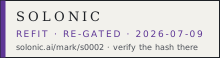
STANDING — record current PROVISIONAL — a required step pending SUPERSEDED — a newer gated version exists WITHDRAWN — misuse or reversal; reason on record
A live record
Sample: our own flagship
solonic.ai/mark/s0001
- Artifact
- The Superintelligence Problem — Probability Map v2.1
- SHA-256
- 01fdd4855ee9cd4b8a9e6e7513a4b631bc9cf597b21c41c8c82a0a305cdf5b00
- Gate
- Caliber Deep · 2026-07-08 · findings E1–E6 published in the artifact’s own §0 and in the errata record
- Refit
- Applied 2026-07-08 · every change traced to a finding
- Standing
- PROVISIONAL — the re-gate after refit was run by the same family that performed the revision, which our own rules do not accept. An independent re-gate is docket item four for the panel. The mark stands PROVISIONAL until it completes — including on our own flagship, which is the point.
Misuse and withdrawal. Displaying a mark on any version other than the hashed one is misrepresentation; we withdraw the mark and the withdrawal is public, dated, and permanent in the registry. The deterrent is not the badge — it is that the registry never forgets.
Why “Sphragis.” Theognis of Megara sealed his verses with a sphragis — a mark set into the text itself so that tampering could be detected. The oldest anti-forgery device in the written corpus. Ours does the same job with a hash.